


Farmers from several locations across the country, including -Miaoli County’s Dapu (大埔), yesterday accused the government of lying and failing to fulfill promises it made last year on land expropriation.
“Article 15 of the Constitution protects people’s right to survival, work and to property. However, the current Land Expropriation Act (土地徵收條例) respects none of those rights,” Hsu Shih-jung (徐世榮), chair of National Chengchi University’s Department of Land Economics, told a press conference at the legislature.
EXPLOITATION
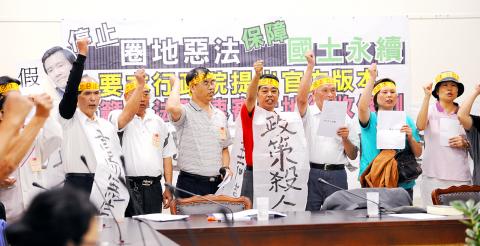
Photo: Lo Pei-der, Taipei Times
“The land expropriation system in Taiwan is a system that deliberately exploits the disadvantaged, because one of its criteria in choosing land for expropriation is to find a location where there will be only ‘minimum resistance,’ which is why most land takeover deals happened to farmers or other disadvantaged groups,” Hsu said.
Last year, President Ma Ying-jeou (馬英九), Premier Wu Den-yih (吳敦義) and Minster of the Interior Jiang Yi-huah (江宜樺) all promised representatives from farming rights advocates — including Hsu — that the government would seek to revise the Land Expropriation Act to better protect farmers’ rights.
“It’s been quite a while and this legislative session is about to end — and yet, still the government has failed to submit any draft amendments to the law,” Hsu said.
“During a press conference to celebrate the third anniversary of his inauguration, Ma talked about human rights; it’s a joke,” Hsu said.
“What about the rights of these farmers? He should stop lying,” he added
Moreover, the government has also broken its promises to the farmers from the farming village of Dapu.
The expropriation of Dapu farms sparked controversy last year when the Miaoli County Government sent excavators escorted by police into rice paddies belonging to landowners who were opposed to a land expropriation deal early in the morning without warning.
AGREEMENT
After a series of protests, Wu intervened and the government agreed to allow 19 households to keep their houses, while compensating landowners with new farmland that came with much needed irrigation systems.
“Both the central and local governments agreed to allow us to keep our homes. However, they changed their mind and now [four] of the houses will be pulled down,” a Dapu resident and spokeswoman for the Dapu Farmers’ Self-Help Association, Yeh Hsiu-tao (葉秀桃), said.
STANDING TOGETHER
Although not all houses would be torn down, they all stood together in solidarity, Yeh said.
Chang Huan-chang (張煥昌), a farmer from Wuri District (烏日), Greater Taichung, whose farmland is also scheduled to be expropriated for an urban development project, said the government should abandon its “economic development first” mentality.
“We need to think about food security,” Chang said. “Taiwan is a country with limited resources, but agriculture is something in which we really should be self-sustainable. As we grow more dependent on food supplies from other countries, we’re placing our future in the hands of others.”

UPGRADE: The Kang Ding-class frigate is replacing its Chaparall missiles with Tien Chien II and Hua Yang VLS, which would provide it with long-range, 360° air defense Taiwan plans to produce 1,200 to 1,376 Hai Chien II missiles (海劍二, Sea Sword II) — also known as TC-2N — to serve as the standard air defense system of the navy’s surface combatant fleet, a source said yesterday. Last week, the Hai Chien II, the naval version of the Tien Kung II missile (天劍二, Sky Sword II), completed a live-fire test in waters off the National Chungshan Institute of Science and Technology’s Jiupeng facility (九鵬) in Pingtung County’s Manjhou Township (滿州). The MIM72 Chaparral and other dated air defense missiles that currently arm Taiwanese ships have inadequate range to combat Chinese

REASONS FOR TRAVEL: An assistant professor said that proposed amendments to penalize drivers if they used drugs overseas would not deter people from traveling People who operate a motor vehicle under the influence of marijuana would have their driver’s license revoked, even if they used the substance while overseas, the Ministry of Transportation and Communications said yesterday, citing proposed amendments to the Road Traffic Management and Penalty Act (道路交通管理處罰條例). The amendments would also authorize the government to revoke the licenses of people determined to have used Category 1 or Category 2 narcotics, even if they were not operating a vehicle while under the influence of drugs, as well as ban them from taking the license test for three years, the ministry said. People aged 18 or

HEAVY WEATHER: Typhoon Jangmi is due to crash straight into the Ryukyus as airlines look to shift flights to larger aircraft or cancel flights to Okinawa entirely Taiwan’s international air carriers announced flight adjustments over the weekend as Typhoon Jangmi is forecast to hit the Ryukyu Islands today and tomorrow. The Central Weather Administration (CWA) upgraded Jangmi from a tropical storm to a typhoon at 8am yesterday, with the eye located 580km south of Naha city. It was moving north at 19kph. Today, China Airlines’ CI-120, CI-121, CI-122 and CI-123 flights between Taoyuan and Naha, Okinawa, have been canceled as well as CI-132 and CI-133 between Kaohsiung and Naha. EVA Air’s BR-112, BR-113, BR-186 and BR-185 flights between Taoyuan and Naha are also canceled. Low-cost carrier Tigerair Taiwan canceled IT-230,

Johanne Liou (劉喬安), a Taiwanese woman who shot to unwanted fame during the Sunflower movement protests in 2014, returned to Taiwan last night after being deported from the US. She is to stand trial in Taiwan for charges involving embezzlement, fraud and drug crimes. The Criminal Investigation Bureau (CIB) said it took her into custody at Taiwan Taoyuan International Airport and would first question her before transferring her to the New Taipei District Prosecutors’ Office. She was arrested upon disembarking a flight from San Francisco that landed shortly before 7pm. Liou absconded to the US in 2019 after jumping bail


 RSS
RSS